grimmly2007.blogspot

  • Subscribe to our RSS feed.
  • Twitter
  • StumbleUpon
  • Reddit
  • Facebook
  • Digg

Sunday, 31 January 2016

अध्यात्मविद्या — adhyātmavidyā (science/knowledge pertaining to the Self within) Newsletter from Srivatsa Ramaswami February 2016

Posted on January 31, 2016 by ravi
February 2016 Newsletter from Srivatsa Ramaswami—  अध्यात्मविद्या
adhyātmavidyā

During January I went to Dubai to teach a 5 day 30 hr yoga program at Yash Saran's beautiful facility called 136.1 yoga. I taught core vinyasas for about 20 hrs and the balance 10 hrs were on Pranayama and Yoga for internal organs. It was a small number of  participants but they all participated fully

Then from January 14 to 29th I was in New Delhi to teach a 100 hr Advanced vinyasakrama TT yoga program. There were more than 30 participants about a third of whom were from outside India. The program had a large chunk (60hrs) of asana vinyasas. Several hundred vinyasas in scores of asana subroutines encapsulated in ten major sequences were taught and practised. Vinyasas done with proper breathing help to stretch the entire skeletal system. All the major skeletal muscles can be accessed by a proper selection of vinyasas on a daily regular basis. Additionally they help to stretch and create a little more intra-articular  space helping the mobility of major joints and the spine. The participants also did a few important asanas that require a considerable time of stay like the Sirshasana, sarvangasana, paschimatanasana and others. Since all were long time yoga practitioners and teachers the level of participation was quite deep and intense. Many managed to stay in major postures like sirsasana, sarvangasana, paschimatanasana, mahamudra and bhagiratasana for even upto 10 minutes. One Sunday many performed 32 suryanamaskara to the chanting of Aruna or suryanamaskara mantras from yajur Veda.
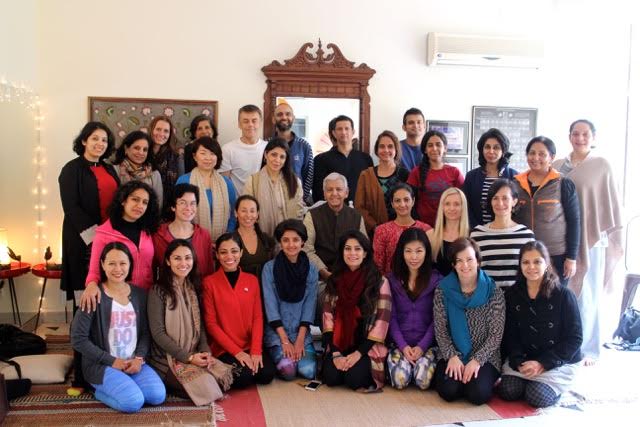


Then there was the 20 hour abhyasa of pranayama, something which is not given its due by contemporary yogis. Considering hatayoga  (union of prana and apana) means pranayama, many paid considerable attention to the study and practice of pranayama. It was heartening to find that many were able to consistently do 80 times viloma ujjayi over a continuous period of 40 to 45 minutes. The program also included a lengthy study of the effect of several yoga techniques towards improving the health of important internal kosas or vital organs. The study included the effect of yoga on heart (hrudaya kosa) and the circulatory system (rakta sanchara), the lungs (svasa kosa) and the respiratory system (prana sanchara), stomach (anna kosa) and the digestive system, intestines (mala losa), kidneys/bladder (mutra kosa) and the urinary system and uterus (garbha kosa) and the reproductive system. Then the nervous system and the spine, the brain as a piece of organ and also the functioning of the brain also known as citta vrittis were also part of the study. Yoga has a few limited but very powerful techniques as vinyasas, asanas, kriyas, pranayama, various mudras and bandhas and meditation all backed by a very strong yoga philosophy. It has a very wide range of applications for physical and mental health.

Then there was the 20 hour portion of study of yogasutras. We went through all the sutras in the four chapters and many paid very close attention to the entire treatment of Rajayoga or yoga of enlightenment by Patanjali.

I had taught the same program in Chennai  at Saraswathy Vasudevan’s Yoga Vahini during November/ December  2015 which was attended by about 35 people. There was some disruption due to the unprecedented rains and unfortunate flooding in Chennai, but still many people managed to attend all the sessions despite enormous difficulties. Again the participation was excellent and it was a great joy to work with such committed  yogis and yoginis.

I intend to repeat this program in a few other places during 2016. Between April 16th and May 1st I will be teaching this program at my friend Ryan Leier's Oneyoga studio in Saskatoon in Canada. 

Then later on between August 23rd and September 8th, I will b teaching this program at Loyola Marymount University where I have been teaching the 200 hour TT program for the last almost 10 years. 

Then between September 24th to October 8th or so, I will be teaching this program in Madrid, Spain at Blanca San Roman’s   studio. Blanca attended the 100 hr program in New Delhi recently and had also earlier attended a shorter program in London.

I am also doing shorter programs at Yogashala Connecticut (May 2016) Blue Point Yoga in Raleigh, North Carolina (May 2016), Chicago Yoga center in Chicago (Sep 2016) and my friend Sriram's place in Germany in Aug 2016. Please refer to the Events page of my website www.vinyasakrama.com/Events for more details as and when they become ready and posted


 अध्यात्मविद्या
adhyātmavidyā

Bhagavan Sri Krishna in the bhagavatgita refers to vidyas or bodies of knowledge. There are hundreds of vidyas that teach us about the various aspects of the universe, its function and those that make our lives happier. However there is very little that is done to systematically study about our own selves. This vidya is called adhyatma vidya and the Lord considers that of all the vidyas he is adhyatma vidya or we may say that the Lord considers this knowledge about the self is the highest or the most important. Many vedic philosophies especially samkhya, yoga and vedanta are said to concentrate on this. Vidya. While there are differences in the ultimate analysis about the nature of the self like if the self is one or many, they all say that the common understanding of the nature of self, an acceptance without any thought or reflection  about the nature of our self as nothing other than our body/mind complex is erroneous, popularly expressed by the term 'avidya'. Samkhya, yoga and vedanta attempt to remove the avidya about oneself and help realize the real nature of oneself. This vidya or knowledge is Adhyatma vidya.

While vedanta and samkhya generally explain the correct nature of the Self, the step by step approach starting from where one's understanding/misunderstanding about the Self is, is undertaken meticulously by Yoga. The body/mind complex which is considered to be the Self by default by everybody however itself is the means by which one has to understand the self. Thus Patanjali before starting his detailed presentation of the classic, 'Ashtangayoga', describes the body/mind system as drisya or the  'seen self'
which is the starting point of analysis of the self. The drisya is made of many prakritic tatvas. It is made of three gunas, satva, rajas and tamas. It is also made of the five bhutas or the gross elements of nature, viz., solid, liquid, gaseous matter apart from heat or fire and occupies space (prithvi, ap, tejas, vayu and akasa). Then it has 13 indriyas .
प्रकाश क्रिया स्थिति शीलं भूतेन्द्रितात्मकं भोगापवर्गार्थं दृश्यम्।
prakāśa kriyā sthiti śīlaṁ bhūtendritātmakaṁ bhogāpavargārthaṁ dṛśyam|
 
prakāśa kriyā sthiti śīlaṁ bhūtendritātmakaṁ bhogāpavargārthaṁ dṛśyam|

 The overwhelming majority of the populace use this drisya atma or the 'seen self' for various experiences , happy and unhappy by doing varying activities or karma some good, some bad and many mixed (three types of karmas). But the yogi first does yogic karma which is said to be non-binding as it has no prakritic or bhoga motivation and is directed towards first reducing/removing the non yogic gunas as Rajas and tamas through a proper mix of yamaniyamas on one hand and asana, pranayama and pratyahara on the other. Only a satvic mind can really remain focused and in a state of samadhi to directly experience the self, This yogic procedure of rolling back the involvement with the outside to derive worldly and other worldly experiences is termed as 'apavarga' by Patanjali. Thus Patanjali stressed the importance of maintaining the drisya atma or the pseudo self in good condition so that it can be refined and put to yogic use.
 

The real self, the observer, also known as Atma, purusha, chit, pratygaatma, drashta, drikshakti is pure unwavering consciousness that observes everything presented to it by citta as cittavrittis. Patanjali brilliantly describes the state and nature of the adhyatma as
द्रष्टा दृशि मात्रः शुद्धोपि प्रत्ययानुपश्यः।
draṣṭā dṛśi mātraḥ śuddhopi pratyayānupaśyaḥ|

The seer/self is only seer or awareness, pure (uncontaminated by any of the prakritic gunas as satva, rajas or tamas). Even so it is required to observe all that is presented by citta as a cittavritti. And the Self never undergoes any change as it is pure awareness;  the cittavrittis are always known to the self , still unchanging and hence immortal
सदा ज्ञाताः चित्तवृत्तयः तत्प्रभोः पुरुषस्य अपरिणामित्वात्।
sadā jñātāḥ cittavṛttayaḥ tatprabhoḥ puruṣasya apariṇāmitvāt |

All these sastras, the nivritti sastras strive hard to show how our perception of what constitutes the self is flawed and by logical step by step approach show what is the real nature of oneself. Once the mind is able to overcome  this erroneous but very common perception of oneself is removed, then one sees oneself and the world clearly as they are and is said to attain freedom or kaivalya or moksha. This vidya or the knowledge of the self, the Lord says, is the most important from his perspective. And yoga is the system that goes about methodically to lead one to this understanding and subsequent realization

Sincerely
Srivatsa Ramaswami
P S If you like the article please share it with friends . Tens of articles are in my previous newsletters, may be accessed from

https://groups.google.com/forum/?hl=en#!forum/vinyasa-krama-announce


Email ThisBlogThis!Share to XShare to Facebook
Posted in Ramaswami newsletters, science pertaining to the Self within. adhyātmavidyā | No comments
Newer Post Older Post Home

0 comments:

Post a Comment

Subscribe to: Post Comments (Atom)

Popular Posts

  • Ashtanga Advanced series? Why does the Advanced series presentations differ from the 'Original' 1973 Ashtanga syllabus
    I was asked a question about Philippa Asher's Advanced B poster and video I posted a link this week in connection to Philippa's arti...
  • Ashtanga Authorisation 1980 - Present. Includes first ONLINE teaching list (Ashtanga.com 2004) and first AYRI teachers list (2008).
    This post will become a permanent page at the top of the blog, a work in progress attempt to chart the development of the Ashtanga Authorisa...
  • Krishnamacharya recommended Four Key asana/mudra..... make that six..
    I was just sent an email asking for a recommendation "What 3-5 yoga poses should all men practice daily?" In several posts in the ...

Categories

  • #proficientprimaryproject
  • 84 key asana
  • active movement
  • Acupuncture
  • Advanced Ashtanga
  • Advanced Ashtanga demonstration
  • Advanced Ashtanga. Advanced asana
  • advanced B
  • Advanced backbending
  • Advanced series ashtanga
  • Ahtanga
  • alternate breathing in ashtanga
  • Antharanga Sadhana
  • Ardha Baddha Padma Paschimattanasana
  • ardha matsyendrasana
  • arm balances
  • Asana and ageing
  • asana as mudra
  • Ashtanga
  • Ashtanga 4th series.
  • Ashtanga 6th series
  • Ashtanga A
  • Ashtanga Advanced series
  • Ashtanga and addiction
  • ashtanga and ageing
  • Ashtanga and Diet
  • Ashtanga and eating
  • Ashtanga and losing weight
  • Ashtanga and menstruation
  • Ashtanga and recovery
  • Ashtanga and Weight lost
  • ashtanga authorisation
  • Ashtanga B
  • Ashtanga books
  • Ashtanga breathing
  • Ashtanga C
  • Ashtanga in midlife
  • Ashtanga interviews
  • Ashtanga Ladies holiday
  • Ashtanga led
  • Ashtanga lineage
  • Ashtanga Parampara
  • Ashtanga practice
  • Ashtanga primary
  • Ashtanga reading list
  • Ashtanga source
  • Ashtanga syllabus
  • Ashtanga teacher Authorisation
  • Ashtanga underwater
  • Ashtanga vinyasa
  • ashtanga vinyasa count.
  • Ashtanga Viswanath
  • Ashtanga yoga london
  • Ashtanga young boys
  • Ashtanga's origins
  • Asymmetric asana
  • Authorisation
  • AVIDYA
  • B.N.S. Iyengar
  • backbending
  • baddha konasana
  • baddha padmasana
  • beginner yoga reading list
  • Beginning Ashtanga
  • beginning Vinyasa krama
  • beginning vinyasa yoga
  • beginning yoga
  • being stopped at a posture
  • bhagavad gita
  • Bharadvajrasana
  • Bharatanatyam
  • BKS Iyengar
  • BNS Iyengar
  • Bohr effect
  • Book review
  • breathing asana
  • breathing in Ashtanga
  • breathing less
  • chakrasana
  • Chinese medicine and Ashtanga
  • chuck Miller
  • CIRCULO BLANCO
  • Conference notes.
  • cultivate
  • current practice
  • Dandasana
  • Danny Paradise
  • David Roche
  • David Swenson
  • David Williams
  • deep backbends
  • developing a Home practice
  • Dharana
  • Dhyana
  • drishti
  • dropback
  • early asana diploma course
  • early ashtanga vinyasa
  • eka pada sirsasana
  • Emergence of Yoga
  • four key asana
  • Gunas
  • Half Ashtanga series
  • Hamish Hendry
  • hands free lotus
  • hatha yoga
  • Hatha Yoga Pradipka
  • headstand
  • headstand variations.
  • headstands
  • Heartfulness meditation
  • Heartfulness meditation and ashtanga vinyasa yoga
  • hidden postures between postures.
  • History of Ashtanga
  • Home practice
  • Home yoga practice
  • in defence of ashtanga
  • Introduction to breath control
  • inversions
  • Invertions.
  • Jessica Walden
  • Kapotasana
  • karandavasana
  • Karandavasana preparation
  • Keshava Murthy
  • key asana
  • Kino intermediate series
  • Kino MacGregor
  • KPJAYI
  • Krishanacharya
  • krishna
  • Krishnamacharya
  • Krishnamacharya and Buddhism
  • Krishnamacharya and drishti
  • krishnamacharya and the gaze
  • Krishnamacharya backbending
  • Krishnamacharya kumbhaka
  • Krishnamacharya pranayama
  • krishnamacharya pranayama in asana
  • Krishnamacharya quotes
  • Krishnamacharya reading list
  • Krishnamacharya. Is Ashtanga hatha or raja yoga
  • Krishnamacharya's 32 headstands
  • Krishnamacharya's Advanced asana
  • Krishnamacharya's Ashtanga Primary series
  • Krishnamacharya's early Mysore works
  • krishnamacharya's inversions
  • Krishnamacharya's key asana
  • Krishnamacharya's Mysore Yoga students 1941
  • Krishnamacharya's Original Ashtanga Yoga
  • Krishnamacharya's practice guidelines
  • Krishnamacharya's pranayama
  • krishnamacharya7s Ashtanga
  • Kumbhaka
  • ladies holiday
  • lagu vajrasanam supta vajrasana
  • Langhana kriya
  • learn dance hand mudras
  • Learn Sanskrit
  • learning sanskrit yoga names
  • Learning Sanskrit.
  • Learning the sanskrit names for Ashtanga primary series. learning the Ashtanga vinyasa count
  • leg behind head poastures
  • lineage
  • Lineage holder
  • Lino Miele
  • lotus
  • Louise Ellis
  • loving kindness
  • Loving kindness and Yoga Sutras
  • M.S. Viswanath (Masterji)
  • maha bhandasana
  • mahabhandasana
  • mahabharata
  • mahamudra
  • manju jois
  • Manju's new Book
  • Mantra pranayama
  • Mark Darby
  • Mary taylor. subtle body.
  • Masterji
  • meanings of Yoga
  • Meditation and Ashtanga Vinyasa Yoga
  • Menstruation
  • metta
  • modified Ashtanga
  • moola bhandasana
  • moolabhandasana
  • mudra
  • Mudras
  • mula bhandasana
  • mulabhandasana
  • My year in posts
  • Mysore Traditions Movie
  • Mysore yoga demonstration 1941
  • Mysore yoga tradition
  • Nancy Gilgoff
  • newsletters
  • No official ashtanga
  • official ashtanga
  • OM The world of Ashtanga Yogis
  • on Series
  • on vinyasa
  • One breath an asana
  • original Ashtanga
  • original ashtanga syllabus
  • Original ashtanga table
  • Original ashtanga vinyasa count
  • origins of Ashtanga
  • Orisginal Ashtanga syllabus
  • padmasana
  • padmasana variations
  • Paramaguru
  • parampara
  • Patabbhi Jois' nephew
  • patanjali
  • Pattabhi Jois
  • Pattabhi jois Advanced series
  • Pattabhi Jois pranayama
  • Pattabhi Jois'
  • Pattabhi Jois' Yoga Journal letter
  • Perter Brooks Mahabharata
  • Philippa Asher
  • phulgenda Sinha
  • Plagerism
  • practice
  • practicing Yoga at home
  • practicing yoga safely
  • pranayama
  • pranayama mantra
  • Pranidhi Varshney
  • preparation for yoga
  • Proficient primary
  • Puraka (inhalation)
  • Purna matsyendrasana
  • Pushpam
  • R. Sharath Jois
  • Raja yoga
  • Ramamohana Brahmachari'
  • Ramaswami
  • ramaswami chanting
  • Ramaswami newsletters
  • Ramaswami pranayama
  • Ramaswami's key asana
  • Ramswami yoga
  • Recaka (exhalation)
  • Richard Freeman
  • Rishi Series.
  • Roots of Yoga
  • Safer yoga practice
  • Samkhya krika
  • Samyama
  • sañcāra
  • sarvangasana
  • Śavasana
  • savasana Ashtanga take rest
  • science pertaining to the Self within. adhyātmavidyā
  • Sharath
  • Sharath jois
  • Sharath Rangaswamy
  • Sharath Rangaswamy Jois
  • Sharath Utkatasana exit
  • Short Ashtanga practice.
  • Simon Borg-Oliver
  • Simon Borg-Olivier
  • Simon Borg-Olivier pranayama
  • sirsasana
  • Sirsasana (headstand) to Gomukhasana
  • Sirsasana variation
  • Sirsasana variations
  • Sirssana
  • Slow Ashtanga
  • Splashtanga
  • SRI T K SRIBHASHYAM
  • Srivatsa Ramaswami
  • Table of asana
  • Taboo
  • Taḍagī Mudra
  • Taittiriya Upanishad
  • tatakamudra
  • Teaching Ashtanga
  • The Art of Ashtanga vinyasa
  • The Four Immeasurables
  • the Gita as it was
  • THE KALAMA SUTRA
  • the Original gita
  • the Source
  • This is yoga 1941
  • This is yoga life magazine
  • three gunas
  • Tirieng Mukha Eka Pada Paschimattanasana
  • Tolstoy
  • Tolstoyism
  • towards karandavasana
  • traditional Ashtanga
  • traditional ashtanga vinyasa
  • triangamukha Uttanasana
  • underwater yoga
  • Upanishads
  • urdhva dhanurasana
  • Utkatasana
  • Uttihita Padangustasa
  • Vicarious Yoga
  • Vinyasa
  • Vinyasa Krama
  • Vinyasa Krama inverted sequence
  • Vinyasa Krama lotus sequence
  • What I believe
  • What is Ashtanga really
  • What is Ashtanga?
  • Why meditation
  • why practice mudras.
  • Why practice yoga
  • Why Yoga
  • Yamini Murthanna
  • Yoga and aeging
  • yoga and ageing
  • Yoga and blood circulation
  • yoga and Diet
  • Yoga and Osteoporosis
  • Yoga and Women
  • yoga chikitsa
  • Yoga for the three stages of life
  • Yoga Korunta
  • yoga korunti
  • Yoga magazine
  • Yoga Makaranda
  • Yoga Meditation
  • Yoga mudra
  • yoga mudras
  • Yoga raading list
  • Yoga reading list
  • Yoga Sutras
  • Yoga Therapy
  • YogaGlo
  • Yogasanagalu
  • yogasanagalu translation
  • Yogavataranam
  • Zoë Slatoff-Ponté

Blog Archive

  • August 2017 (10)
  • July 2017 (5)
  • June 2017 (7)
  • May 2017 (6)
  • April 2017 (6)
  • March 2017 (9)
  • February 2017 (7)
  • January 2017 (7)
  • December 2016 (4)
  • November 2016 (6)
  • October 2016 (8)
  • September 2016 (6)
  • August 2016 (4)
  • July 2016 (6)
  • June 2016 (4)
  • May 2016 (2)
  • April 2016 (4)
  • March 2016 (16)
  • February 2016 (13)
  • January 2016 (15)
  • December 2015 (5)
Powered by Blogger.

Search This Blog

Report Abuse

  • Home

About Me

ravi
View my complete profile